Case 11 / Aircraft sizing
Conceptual transport-aircraft sizing
Explore how payload, range and fuel assumptions affect takeoff mass, alongside the mission and payload-range plots from a transport-aircraft sizing study.
Mission sizing · payload-range analysis · mass-budget explorerMission sizing, weight convergence and performance analysis
How do payload and mission assumptions change the mass that a conceptual aircraft needs to carry?
The project covers mission sizing, weight convergence, constraint analysis and payload-range performance. The interactive mass-budget explorer isolates the relationship between payload, fuel and takeoff mass, allowing the effect of mission range and passenger count to be examined directly.
Method and workflow
- 01
Describe the mission
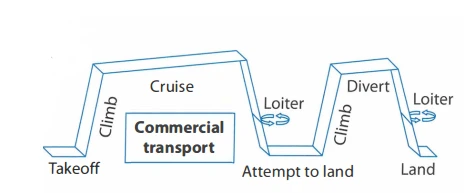
State range, passengers, crew, cruise assumptions, loiter and diversion.
- 02
Account for fuel
Combine segment retention factors with a declared cruise relation and reserve allowance.
- 03
Close the mass balance
Require takeoff mass to equal payload and crew, empty mass and mission fuel.
- 04
Read the trade
Change payload or range and inspect which mass contribution grows. Constraints and geometry require a separate design stage.
Give the mission a mass budget.
Empty fraction: 0.48. Cruise: 230 m/s, L/D 18, fuel-consumption rate 0.5 h⁻¹. Add 30 minutes loiter, a 200 nm diversion, segment allowances and a 6% reserve multiplier on fuel fraction.
Allow 100 kg per passenger and per crew member, including baggage. The model holds the empty-mass fraction fixed; a structural-weight regression is a separate sizing step.
This example illustrates takeoff-mass balance under the selected mission assumptions. The original constraint and payload-range calculations are shown separately in the project figures.
Project figures
Model assumptions and scope
- The interactive mass-budget model uses a fixed 48% empty-mass fraction and specified mission segments.
- The project figures include the full sizing-study outputs. The interactive mass-budget model isolates mass closure and does not recalculate structural weight, constraint intersections or the complete payload-range envelope.
Potential extensions
Extend the example with a weight regression and constraint analysis, using a single documented mission definition.
Let’s work through it.
Robotics, simulation and control consultation across Canada, with remote support available internationally. Share your system and the result you need.