Case 06 / Planning & numerical methods
Obstacle-aware UAV trajectory planning
Turn an obstacle-free route into a smooth trajectory using convex corridors and Bézier curves, with explicit limits on motion.
Research outputs · interactive plannerHow do you turn a collision-free route into a smooth trajectory that a controller can follow?
I developed trajectory-planning tools using search, convex corridors, differential flatness and Bézier representations, with a web interface for inspecting the path and motion constraints.
Method and workflow
- 01
Describe free space
Specify the operating boundary, obstacles, start and destination.
- 02
Find a connected route
Use graph or sampling-based search to discover a route through the obstacle geometry.
- 03
Construct safe corridors
Build connected convex regions around the route to constrain trajectory optimization.
- 04
Optimize the motion
Fit a smooth curve and inspect velocity, acceleration, jerk and continuity constraints.
From RRT search to a smooth trajectory.
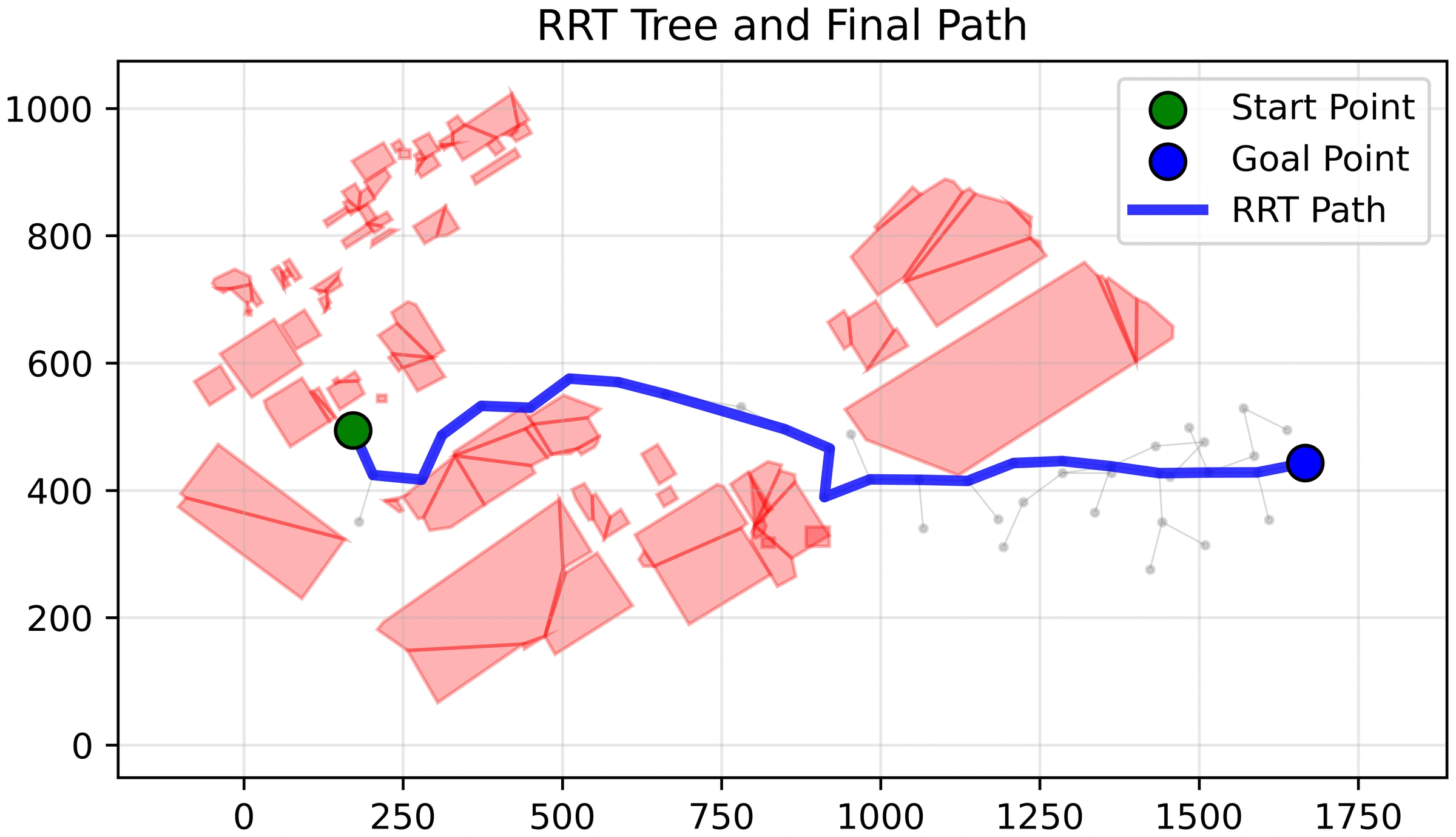
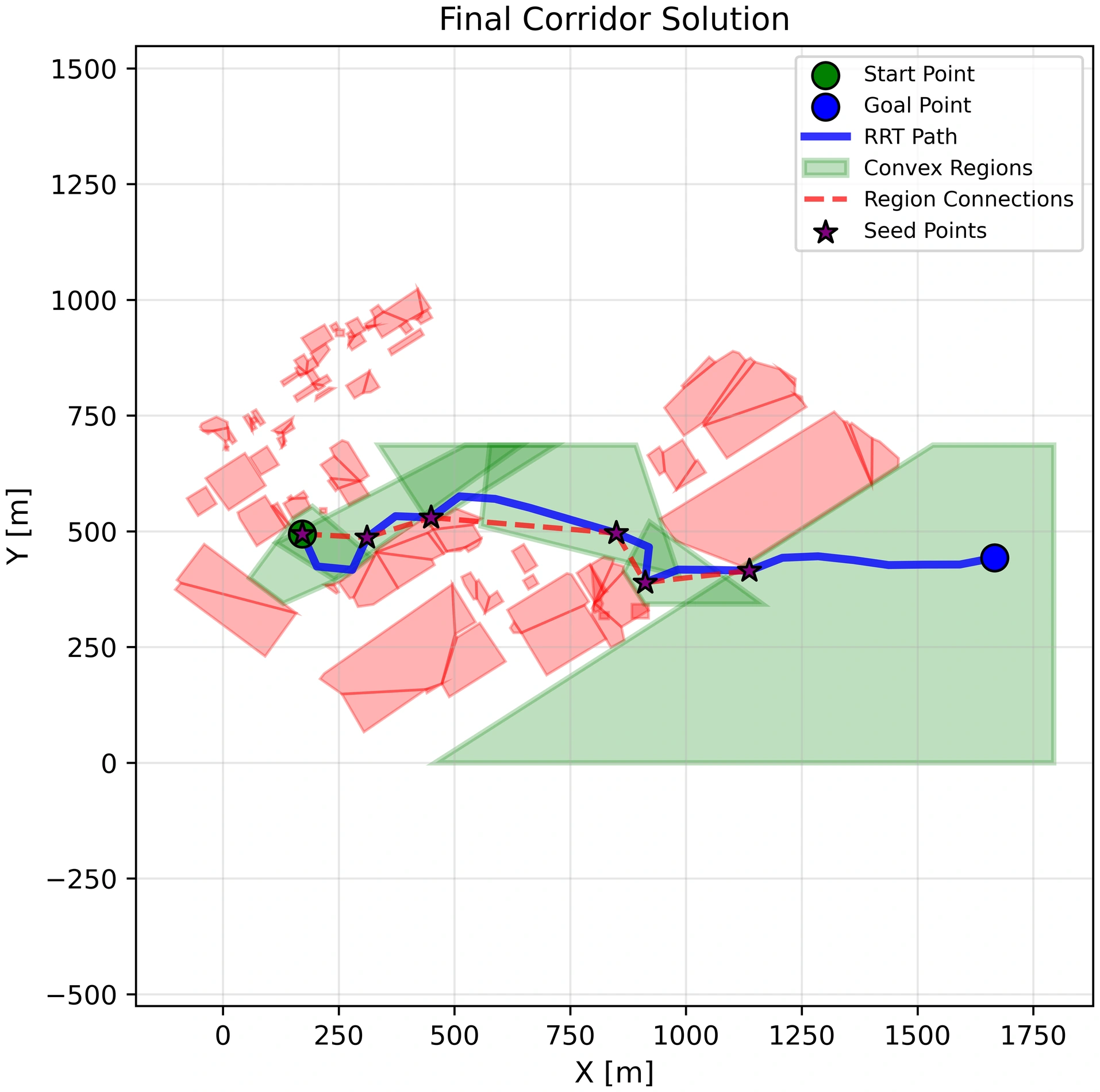
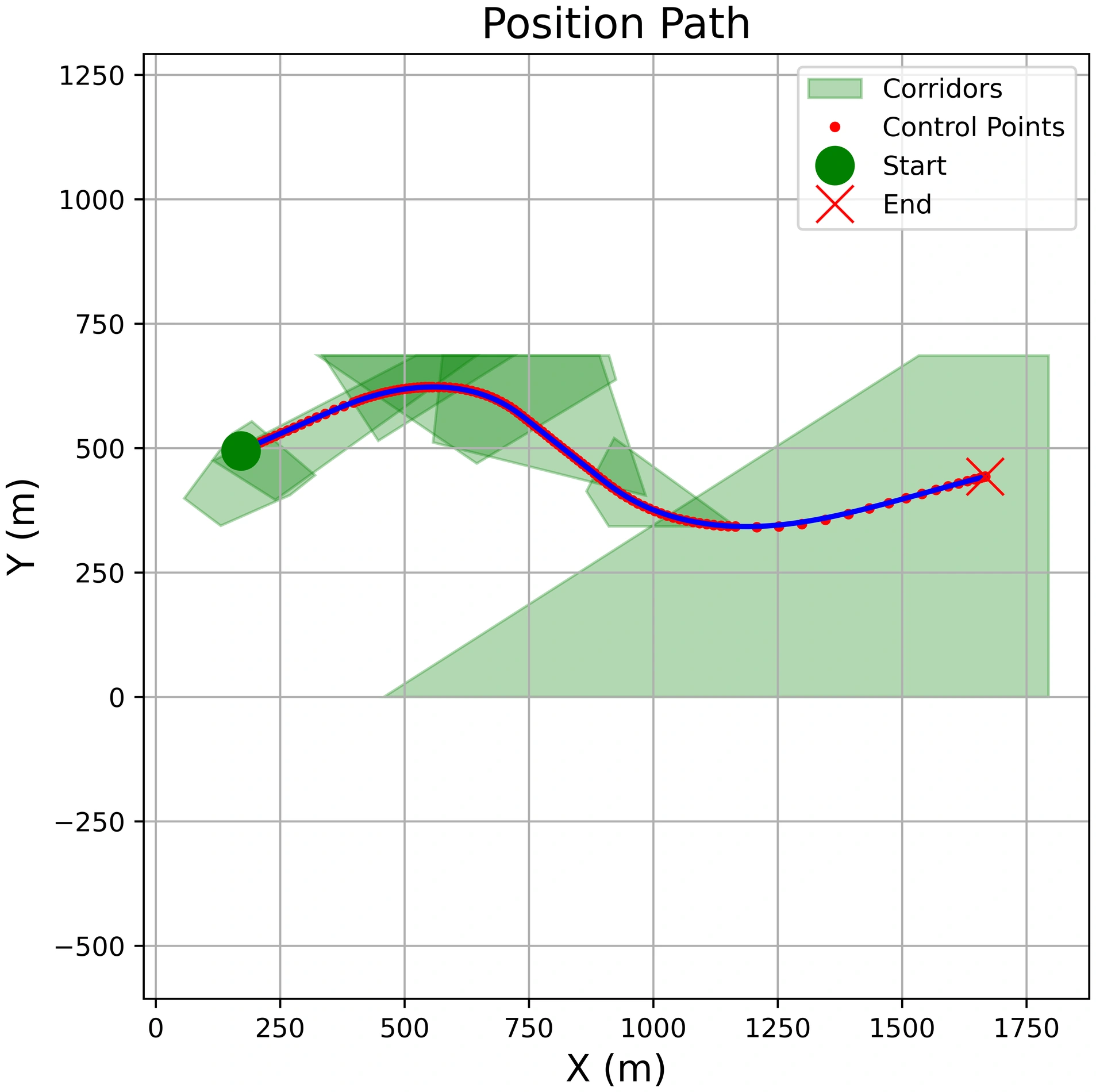
One map, from the initial RRT route through corridor construction to the optimized Bézier path.
RRT path
The RRT search finds a route between the start and goal around the obstacles.
 Open full-size figure ↗
Safe convex corridors
Connected convex regions form a safe corridor around the RRT route.
 Open full-size figure ↗
Optimized Bézier path
The smooth Bézier path stays within the corridors, with its control points shown in red.
 Open full-size figure ↗
Model assumptions and scope
- The figures show planning results. Executing a trajectory on an aircraft requires a separate control and flight-test stage.
- Dynamic feasibility depends on the vehicle model, selected constraints and time allocation.
Potential extensions
Use repeated seeded scenarios to compare solve time, infeasibility handling and trajectory constraint margins.
Let’s work through it.
Robotics, simulation and control consultation across Canada, with remote support available internationally. Share your system and the result you need.